Northern Cardinal: A Backyard Guide
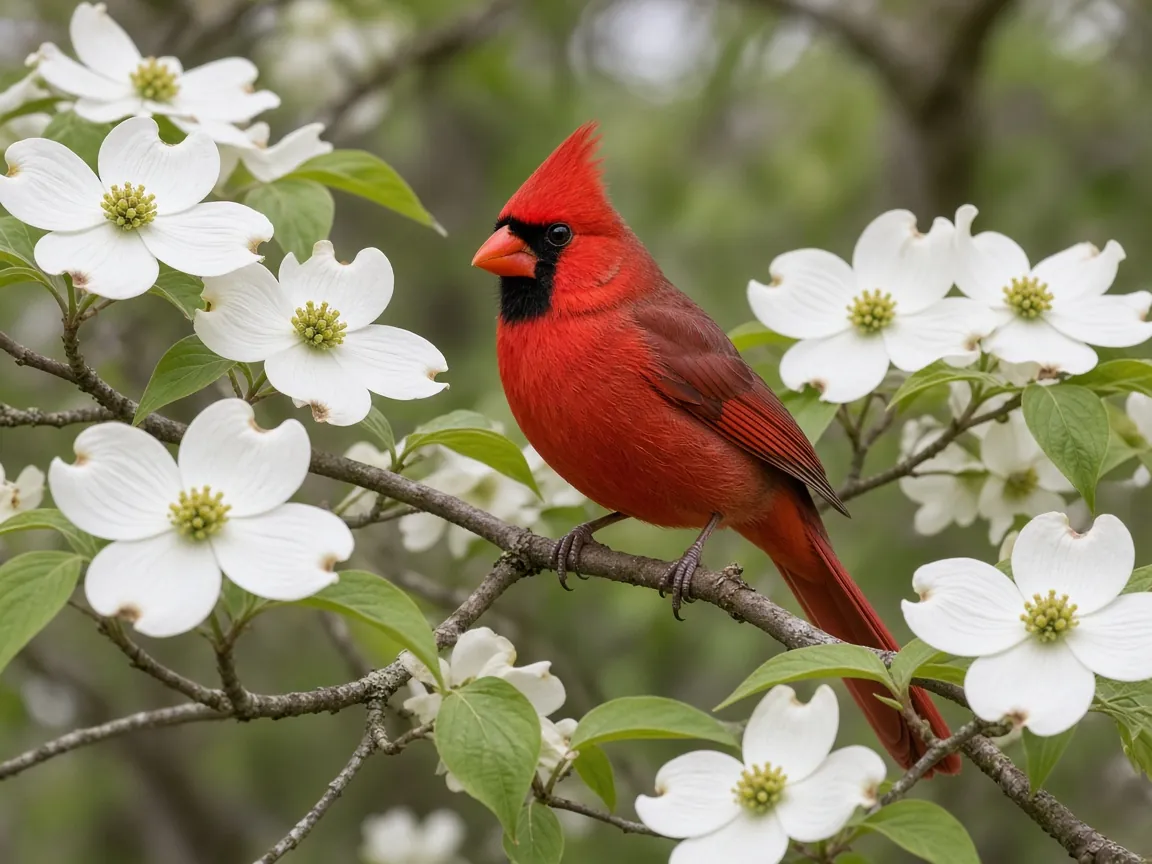
The northern cardinal is one of the most recognizable backyard birds in the eastern and central United States. Bright, year-round and often loyal to the same yard, it is an ideal species for beginners to learn first, including the less obvious female and juvenile.
Quick identification
- Size: a little smaller than an American robin.
- Shape: a pointed crest, a long tail, and a thick, cone-shaped bill built for cracking seeds.
- Adult male: bright red overall with a black mask around a red-orange bill.
- Adult female: warm tan to olive-brown with reddish tinges on the crest, wings and tail, plus the same orange-red bill.
- Juvenile: similar to the female but with a dark, grayish bill and a scruffier look.
The female is the most commonly misidentified cardinal. If you see a brownish, crested bird with a thick orange bill, it is very likely a female cardinal, not a different species.
Where cardinals live
Northern cardinals are found across much of the eastern half of the United States, south into Mexico, and in parts of the desert Southwest. Over the past century their range has expanded northward, and they are now common in many northern states as well. They generally do not migrate, so the pair in your yard in January may be the same pair nesting in your hedge in May.
Cardinals favor edges: shrubby borders, thickets, hedgerows and gardens with dense cover. A yard with layered shrubs gives them both shelter and nesting spots.
Voice
Cardinals are strong singers. Their songs are clear, loud whistles, often described as "cheer-cheer-cheer" or "birdie-birdie-birdie." Unusually among North American songbirds, female cardinals sing too, sometimes from the nest. Both sexes give a sharp, metallic "chip" that is worth learning, because you will hear it from shrubs long before you spot the bird.
Behavior to watch for
- Early and late feeding: cardinals are often among the first birds at a feeder in the morning and the last at dusk.
- Ground and platform feeding: they prefer wide, stable perches and often feed on platform feeders or on the ground below feeders.
- Courtship feeding: in spring, males may pass seeds to females beak to beak.
- Window "fighting": in breeding season, some cardinals attack their own reflection in a window or car mirror, treating it as a rival. It is territorial behavior, not illness.
What cardinals eat
In the wild, cardinals eat seeds, fruits and insects; insects are especially important for nestlings in summer. At feeders they readily take black oil sunflower seed and safflower seed. Safflower is often suggested for yards where squirrels or certain blackbirds dominate, since some of those visitors tend to show less interest in it, although results vary by yard. See our bird seed guide for more.
Nesting basics
Cardinals usually build cup nests low to moderately high in dense shrubs, tangles or small trees. Nesting season generally runs from spring through late summer, and pairs may raise more than one brood. If you find a nest, observe from a distance, keep pets away, and avoid trimming that shrub until nesting is finished. Disturbing active nests can cause adults to abandon them, and native songbirds and their active nests are protected under the federal Migratory Bird Treaty Act.
Making your yard cardinal-friendly
- Plant or keep dense native shrubs for cover and nesting.
- Offer a stable platform or hopper feeder with sunflower or safflower seed.
- Provide clean, shallow water; see birdbath basics.
- Reduce window collision risk if a cardinal is fighting its reflection; see window collision prevention.
Look-alikes and confusion
- Pyrrhuloxia (desert Southwest): gray with red accents and a yellowish, curved bill.
- Summer tanager: also red, but no crest and a paler, longer bill.
- House finch males: red on head and breast but much smaller, with brown streaks and no crest.
Common mistakes
- Calling a female cardinal a "different brown bird."
- Assuming a bird is sick because it attacks windows in spring.
- Trimming dense shrubs in the middle of nesting season.
- Expecting the dull juvenile bill to match the adult's bright orange.
Cardinal checklist
- Crest present
- Thick, cone-shaped bill (orange-red in adults)
- Black mask around the bill
- Red male or warm tan female
- Loud whistled song or sharp metallic chip
- Feeding low, often at dawn or dusk
Not sure whether your bird is a cardinal? Try the Backyard Bird ID Helper and compare with a trusted field guide.
Questions beginners ask
Why does a cardinal keep hitting my window?
In spring and summer, territorial cardinals sometimes attack their reflection. Breaking up the reflection on the outside of the glass, for example with tape, soap patterns or a screen, usually helps. The behavior tends to fade after the breeding season.
Do cardinals mate for life?
Cardinal pairs often stay together through a breeding season and sometimes across years, but 'for life' is an oversimplification. Pairs may change, and studies have recorded both long-term pairs and new partnerships.
Why does my cardinal look bald?
Late summer and fall is molt season. Some cardinals, often young birds, lose head feathers at once and look temporarily bald. Feathers usually grow back within weeks. If a bird seems ill or injured, contact a licensed wildlife rehabilitator.
Helpful public resources
- Migratory Bird Treaty Act of 1918 — U.S. Fish & Wildlife Service
- Feeding Birds (feeders, foods, cleaning, placement) — Project FeederWatch
Links go to independent organizations. BackyardBirdAtlas is not affiliated with them.
Educational information only. Bird ranges and timing vary by region. For uncertain identifications, check a trusted field guide or ask local birding experts. For injured or sick birds, contact a licensed wildlife rehabilitator. See our disclaimer.